
The counterintuitive truth about crypto wallet security is that a stronger wallet does not make a careless transaction safe. Most serious losses do not begin with someone guessing a seed phrase; they begin when a user authorizes the wrong message, grants an excessive token approval, or follows a convincing link to a malicious application. Security, therefore, is not only a matter of keeping keys secret. It is also a problem of understanding what a wallet is asking you to sign.
This distinction matters particularly in DeFi, where one browser wallet may interact with lending markets, decentralized exchanges, bridges, liquid staking protocols, and networks with different fee assets and transaction formats. A multi-chain wallet such as Rabby is designed to make that complexity more visible. That can reduce certain mistakes, but it cannot eliminate malicious contracts, compromised websites, or rushed decisions. The useful question is not whether a wallet is “safe” in isolation. It is how the wallet changes the user’s decision process—and where that process still breaks.
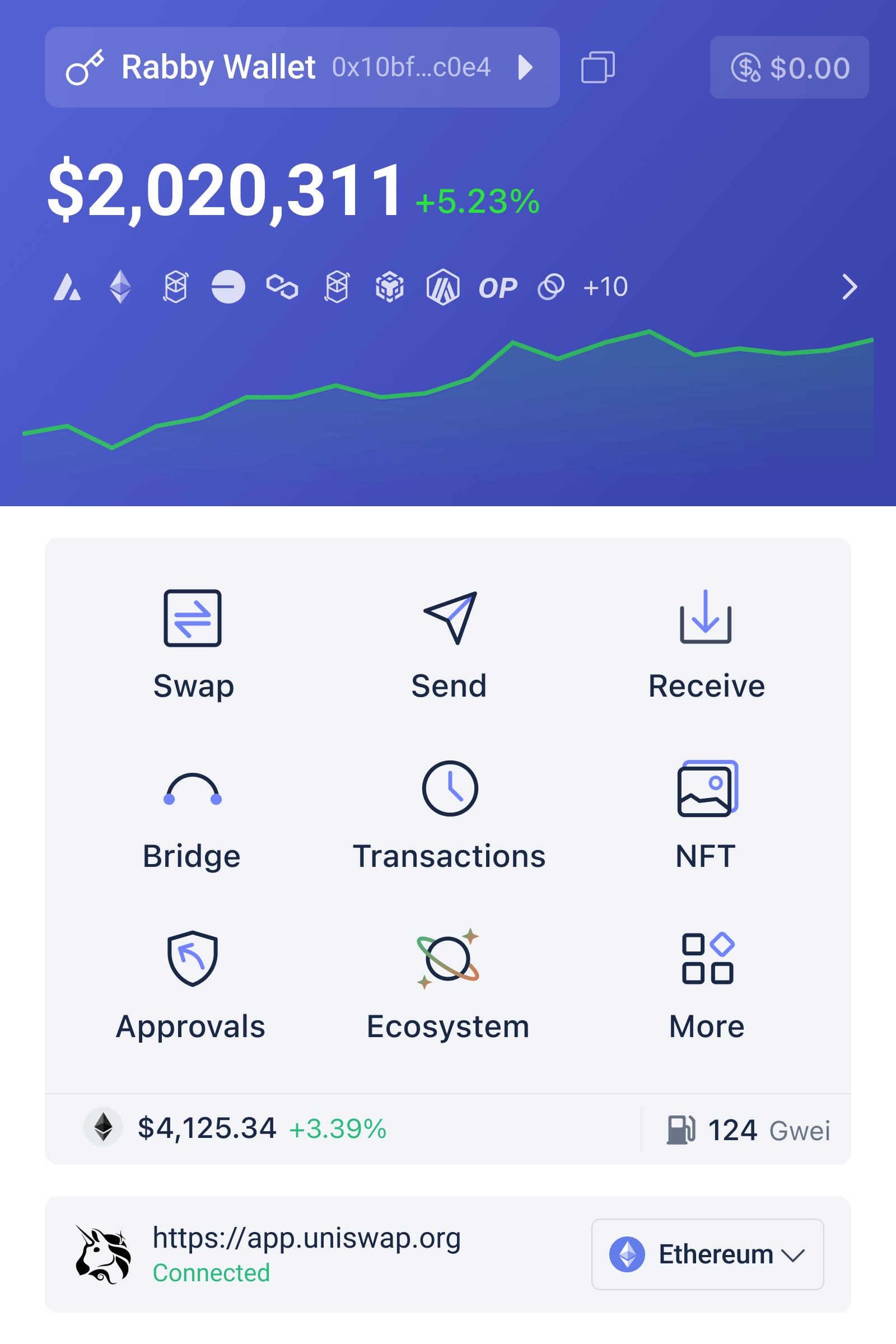
From Key Storage to Transaction Interpretation
Early browser wallets made an important breakthrough by allowing users to connect directly to decentralized applications without handing over custody of their private keys. The basic model was simple: the wallet stored or accessed the signing key, the website prepared a transaction, and the user approved it. That model was convenient, but it placed a heavy burden on the user. Raw contract data and unfamiliar addresses often made it difficult to tell whether a proposed action was a token swap, a permanent approval, or a transfer of valuable assets.
As DeFi expanded across Ethereum-compatible networks and other chains, the wallet’s role changed. It became not merely a key container, but an interpretation layer between a user and a smart contract. A smart contract is software deployed on a blockchain that can hold assets and execute predefined instructions. When a wallet presents a human-readable summary of a transaction, estimates its effects, or warns about a suspicious interaction, it is attempting to translate contract behavior into a decision a person can evaluate.
That translation is valuable, but it is not the same as proof of safety. A transaction simulation may indicate that a swap is expected to produce a certain result, while the protocol itself could still contain a flaw or be governed by an administrator with significant privileges. A warning system may identify a known malicious address, yet fail to recognize a new scam. The right mental model is a car’s dashboard: it provides useful signals about the system, but it does not replace attention, maintenance, or judgment.
What a Multi-Chain Wallet Changes
Multi-chain access introduces a practical security problem that is easy to underestimate: users must manage not only accounts, but also network context. A token with a familiar name may exist on several chains. A bridge may require a source network and a destination network. A transaction may appear normal while the wallet is connected to an unintended chain or account. Confusing these contexts can produce operational errors even when no attacker is present.
A wallet designed for multi-chain DeFi can help by grouping networks, displaying balances in a unified interface, and warning when a transaction appears inconsistent with the selected chain or account. It may also make it easier to inspect the expected outcome before signing. These features are especially useful for US users who may move between mainnet applications, layer-2 networks, and other ecosystems to manage fees or access liquidity.
Yet convenience creates its own trade-off. The more networks and applications a wallet brings into one interface, the more powerful the user’s operational reach becomes. That increases the consequences of a mistaken click. A person who keeps a single account connected to every protocol may find multi-chain access efficient, but the account also becomes a concentrated point of failure. Security architecture should therefore separate roles where possible: a long-term holding account, a lower-value DeFi account, and perhaps a dedicated testing account.
This is a sharper distinction than the common advice to “use a reputable wallet.” Reputation may reduce the chance of installing obvious malware, but it does not prevent a legitimate wallet from being used to sign a harmful authorization. Wallet security has at least three layers: protecting the secret key, authenticating the software and website, and evaluating the action before approval. Improvement at one layer does not compensate automatically for failure at another.
Myths That Create False Confidence
Myth: A transaction preview guarantees that the transaction is safe
A preview can expose important information: which assets may leave an account, which assets are expected in return, what contract is being called, and whether an approval is involved. That is a meaningful improvement over signing opaque data. However, previews depend on the wallet’s ability to interpret the contract and predict its behavior. Complex protocols, unusual token logic, rapidly changing market conditions, or maliciously constructed calls can limit that visibility.
The practical rule is to treat a preview as an inspection aid, not an insurance policy. If the expected result is unclear, stop. If a site asks for an approval that appears unrelated to the action, investigate. A swap should not casually require unlimited access to unrelated assets, and a simple claim should not be assumed harmless merely because the expected reward is small.
Myth: A hardware wallet makes phishing irrelevant
Hardware wallets protect private keys by keeping signing material in a separate device. They can materially reduce the risk that malware extracts a seed phrase from a computer. But the device may still be asked to approve a transaction prepared by a deceptive website. If the user confirms the wrong contract interaction, the hardware wallet can perform its security function perfectly while the asset is lost.
Hardware signing is best understood as protection against key theft, not protection against authorization mistakes. Combining it with a wallet that provides clearer transaction context can improve the overall process, but the user must still verify the application, domain, contract purpose, and requested permissions.
Myth: Token approvals are harmless because no transfer happened yet
An approval gives a smart contract permission to move a specified token from an account, sometimes up to a very large limit. The approval itself may not transfer funds immediately, which is why users often dismiss it. The danger is that the permission can remain active and later be used by the contract, or by an attacker who has gained control of the relevant protocol.
Approval management is therefore part of wallet hygiene. When practical, users should prefer limited allowances, review whether an approval is still needed, and revoke permissions that no longer serve a purpose. Revoking can involve network fees, and it does not repair a transaction already executed. Still, reducing unnecessary standing permissions narrows the damage available to a compromised or misused contract.
Installing and Using the Extension More Carefully
For readers evaluating the rabby extension, the installation step deserves more attention than it usually receives. Browser extensions operate close to the websites a user visits, so authenticity matters. Begin from a trusted official project channel or a carefully verified source, check the publisher and requested permissions, and avoid search advertisements or unsolicited messages that redirect to a download page. A familiar logo is not evidence of authenticity; phishing copies often reproduce visual branding convincingly.
After installation, create or import wallets only through the extension’s genuine interface. Never type a seed phrase into a website, support form, direct message, or “synchronization” page. Store backup words offline and treat anyone requesting them as an attacker, regardless of the claimed affiliation. A browser extension can improve transaction awareness, but it cannot recover a seed phrase that has been exposed.
Before approving a DeFi transaction, use a repeatable pause. Confirm the active account, the network, the destination or contract, the assets leaving the wallet, the assets expected in return, and any approval amount. Then ask whether the action makes economic sense. This last question is often overlooked: a transaction can be technically authentic and still be financially irrational because of slippage, fees, liquidation risk, or an unfavorable market.
A useful operating framework is “identity, intent, impact.” Identity asks whether the wallet, website, contract, and network are the ones you intended to use. Intent asks what the transaction is actually requesting. Impact asks what permissions or assets could remain exposed after the transaction succeeds. The framework is deliberately simple. Its value comes from forcing the user to inspect the action rather than treating a wallet prompt as a routine confirmation.
Limits, Uncertainty, and What to Watch Next
No wallet interface can independently establish that a protocol’s code is bug-free, its governance is honest, or its economic model will remain solvent. Security alerts can be incomplete, simulations can fail on unusual interactions, and legitimate applications can later become compromised. There is also a human-factors limit: repeated warnings may become background noise, especially when users are chasing time-sensitive yields or reacting to market volatility.
The most plausible direction for multi-chain wallets is not perfect automation, but better separation between understandable actions and genuinely ambiguous ones. If wallet tooling becomes more effective at highlighting durable permissions, unusual contract behavior, and cross-chain context, users may make fewer routine errors. That outcome would depend on accurate detection, clear explanations, and interfaces that do not train users to dismiss every warning. The evidence available here does not justify predicting a specific product milestone or feature release; the broader implication is conditional on those design improvements being implemented well.
For now, the strongest security posture is layered. Use authentic software, protect the seed phrase, separate high-value holdings from experimental DeFi activity, verify the site and network, limit approvals when feasible, and treat transaction previews as evidence to examine rather than a guarantee. Rabby-style transaction awareness can make the multi-chain environment more legible. It cannot make an unsafe decision safe after the user has approved it.
Frequently Asked Questions
Is a browser wallet suitable for long-term cryptocurrency storage?
It can be used for long-term storage, but a browser-connected account is exposed to more frequent interaction with websites and contracts. Many users reduce risk by keeping long-term holdings in a separate account, often with hardware-backed signing, while using a lower-value account for routine DeFi activity. The appropriate arrangement depends on the value at risk and the user’s ability to manage backups securely.
Does a multi-chain wallet remove the need to verify the network?
No. It may make network selection easier, but the user remains responsible for confirming that the application, account, asset, and chain match the intended action. Similar token names and cross-chain representations can create confusion, particularly when bridges or layer-2 networks are involved.
What should I do if a wallet warning appears?
Do not treat the warning as an inconvenience to click through automatically. Recheck the website, contract, requested permission, account, and expected outcome. If the action is not clear, reject it and investigate through an independent, trusted channel. A missed opportunity is usually less costly than an irreversible approval to the wrong contract.